xxxadmin1 No Comments

🚗 California Auto Insurance Liability Limits Are Increasing in 2025 — What Drivers Need to Know

Starting January 1, 2025, California drivers will be required to carry higher auto liability insurance limits for the first time in decades. These changes are designed to better reflect today’s medical costs, vehicle repair expenses, and the financial realities of serious accidents.

If you haven’t reviewed your auto insurance coverage recently, now is the perfect time.


What Are California’s New Auto Liability Limits?

Under California law, auto liability insurance pays for injuries and property damage you cause to others in an accident. It does not cover your own vehicle or medical bills.

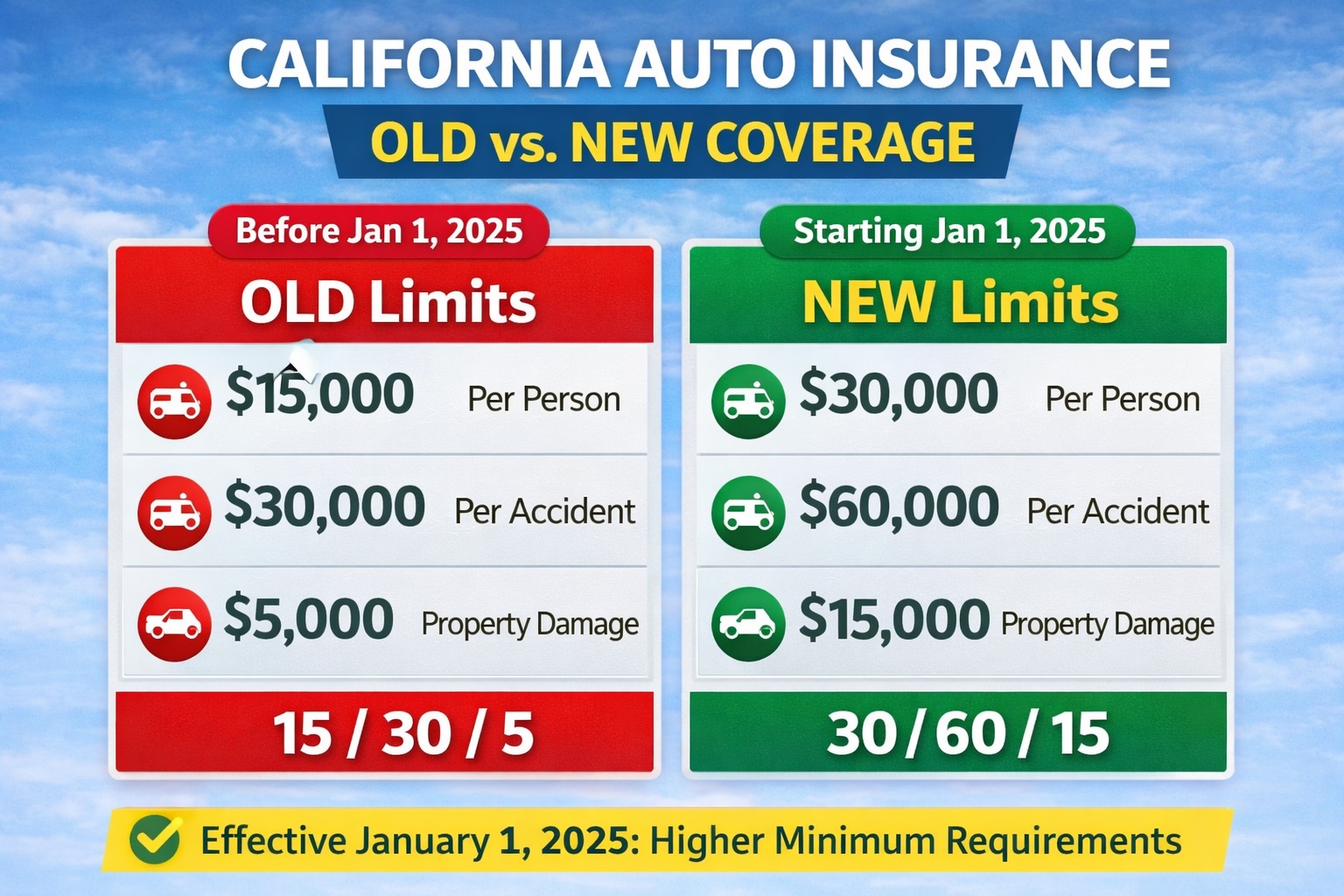
As of January 1, 2025, the new minimum liability limits are:

  • $30,000 for bodily injury per person
  • $60,000 for bodily injury per accident
  • $15,000 for property damage

These limits are commonly written as 30 / 60 / 15.

This is a major increase from the previous minimum of 15 / 30 / 5, which had not changed in over 50 years.

Important: The new limits apply when your policy renews on or after January 1, 2025.


Why Minimum Coverage May Not Be Enough

While the new minimum limits are higher, they may still fall short in a serious accident.

  • Emergency room visits can easily exceed $30,000
  • New vehicle repairs often exceed $15,000
  • Multi-vehicle accidents can quickly exceed $60,000

If damages exceed your policy limits, you are personally responsible for the remaining balance — which could put your savings, home, or wages at risk.

That’s why many drivers choose higher liability limits for added protection and peace of mind.

California Auto Liability Coverage Options (2025)

Below is a comparison of minimum and higher coverage options, so you can see what level of protection may be right for you.

Auto Liability Coverage Options

Coverage Option Bodily Injury
Per Person / Per Accident
Property Damage Ideal For
State Minimum $30,000 / $60,000 $15,000 Legal compliance only
Better Coverage $50,000 / $100,000 $50,000 Common customer upgrade
Recommended $100,000 / $300,000 $100,000 Most drivers
High Coverage $250,000 / $500,000 $100,000 Homeowners & assets
Very High Coverage $500,000 / $500,000 $250,000 Maximum protection
Umbrella Policy +$1,000,000+ +$1,000,000+ Extra layer above auto limits
Tip: Higher liability limits are often more affordable than people expect and can protect your savings, home, and future income.

What Coverage Is Right for You?

  • Minimum coverage may meet legal requirements, but offers limited protection
  • $100 / 300 / 100 is widely recommended for most drivers
  • Higher limits or umbrella policies are ideal for homeowners, families, and anyone with assets to protect

Every driver’s situation is different. The right coverage depends on your income, assets, and risk tolerance.


Need Help Choosing the Right Coverage?

At Yessenia’s Insurance Services, we help drivers understand their options and choose coverage that fits their needs — not just the minimum required by law.

📞 Contact us today to review your policy before your next renewal and make sure you’re properly protected.

xxxadmin1 No Comments

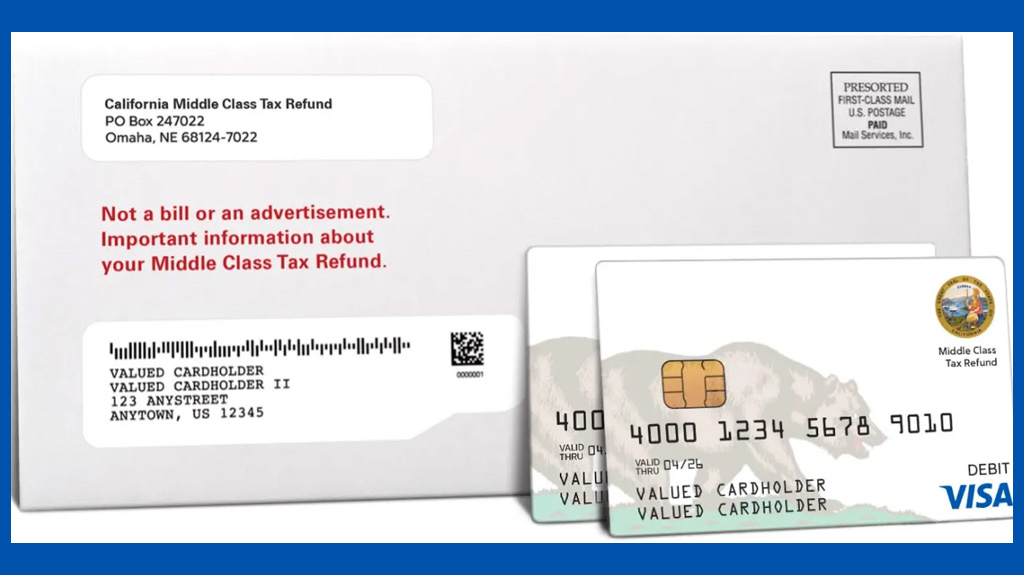
IRS says California’s middle-class tax refund doesn’t need to be reported as taxable 

SACRAMENTO, Calif. — It’s that time of year again…

Tax season is here and if you have questions about filing, we want to help get you answers. Everyone is asking?

Do California taxpayers who received stimulus checks have to pay taxes on them?

The short answer for 2022 filers is no. The IRS says California’s middle-class tax refund doesn’t need to be reported as taxable.

Contact us if you have any additional questions? 818 899-9617

xxxadmin1 No Comments

Golden State Stimulus II


How to qualify, you must:

  • File your 2020 taxes by October 15, 2021
  • Have a California Adjusted Gross Income (CA AGI) of $1 to $75,000 for the 2020 tax year. For this information refer to:
    • Line 17 on Form 540
    • Line 16 on Form 540 2EZ
  • Have wages of $0 to $75,000 for the 2020 tax year
  • Be a California resident for more than half of the 2020 tax year
  • Be a California resident on the date payment is issued
  • Cannot be claimed as a dependent by another taxpayer
    • A dependent is a qualifying child or qualifying relative. Go to FTB Publication 1540 for more information about a qualifying child and qualifying relative

When you’ll receive your payment:

We anticipate that payments will begin in September 2021.

Stimulus payment deadline

To make sure you receive your payment, file a complete 2020 tax return by October 15, 2021.

If you have an ITIN

If you have an ITIN and meet all the GSS II requirements, these are the amounts you may receive. 

ScenarioStimulus amount
Qualified for GSS I
Claimed a credit for 1 or more dependents)
$1,000
Qualified for GSS I
Did not claim a credit for 1 or more dependents
You do not qualify for GSS II

If you are married filing separately, visit Married filing separately for more details.

xxxadmin1 No Comments

Unemployment Income $10,200

The $1.9 trillion Covid relief bill gives a tax break on unemployment benefits received last year. The measure allows each person to exclude up to $10,200 in aid from federal tax.

The bill made the first $10,200 of unemployment income, or $20,400 for married couples filing jointly, tax-free for filers with 2020 adjusted gross income of less than $150,000 (for both singles and couples). This applies to your federal tax return. In California Unemployment is nontaxable.

Who’s eligible?

Not everyone qualifies for the tax cut. Only people who earned less than $150,000 in 2020 are eligible.

This income threshold operates as a cliff: Anyone who earned $150,000 or more last year doesn’t get any of the tax break.

The $150,000 ceiling is the same for all taxpayers, regardless of filing status, such as single or married.

One wrinkle: Taxpayers must use their total unemployment benefits received when determining their income eligibility for the tax break.

xxxadmin1 No Comments

IHSS Income from Taxes

Are you getting a w-2 because you provide In-Home Supportive Services? If you do not pay taxes on this income, can you still get an earned income credit? And child tax credit? There is not (yet) a published IRS regulation on this topic. However, in this court ruling, it was found that tax credits can be claimed.  Please consult with your Yessenias Income agent for more information on In-Home Supportive Services.

IHSS In-Home Supportive Services payments can still be included on taxes and excluded from gross income. This is critical because they still can affect the tax credits or other tax-related matters, such as qualifying income for contributing to a Roth IRA. Make sure to bring in all your forms when you come to do your income taxes so that a tax consultant can go over the benefits and help you get the maximum refund you qualify for.

See more information on Medicaid Waiver Payments May Be Excludable on the IRS website. This is new information relating to this subject. It is important to file your income tax and remind your tax preparer about IHHS services you are providing for your clients. If you come to Yessenias our agents will remind you if you provide this service as we like to go into detail with our customers and find them the maximum return. If you are not a customer come to one of our offices for a free estimate. In-Home Supportive Services is a very complex topic and we are here to help.

xxxadmin1 No Comments

Uninsured Driver – What Happens If I Get In A Wreck With An Uninsured Driver?

Most states have mandatory minimum auto insurance laws, but some people still drive as uninsured drivers. The Insurance Information Institute (III) reports that in a recent study, 13%, or one in eight drivers in the U.S. is operating a vehicle without insurance. Many such drivers cannot afford the cost of car insurance, which makes it difficult to collect damages after an accident. Fortunately, there are ways to protect yourself if you have been involved in a wreck with an uninsured driver.

Uninsured Motorist Coverage

Uninsured motorist protection is a type of auto insurance designed to protect you if a driver without insurance causes a car collision. Hit and run accidents are also covered. This coverage is optional in most states but required in others. If the driver who caused the crash has no car insurance, your uninsured motorist coverage will kick in to cover your damages, up to your policy limits.

xxxadmin1 No Comments

Gov. Newsom: California Starts Moving Into Phase 2 Reopening This Friday May 8,

What DOES this include?
Places like:
– Non-essential manufacturing (toys, furniture, clothing, etc.)
– florists
– bookstores
– sporting goods stores

-Schools & Childcare facilities

-Offices where working remotely isn’t possible, but can be modified to make the environment safer for employees

All with curbside pick-up.

What does this NOT include at this time?
Places like:
– -Shopping Malls
– Restaurants (seated dining)
– Offices (can continue telework)

xxxadmin1 No Comments

Non-Filers with eligible children need to act by this Wednesday to add money to their EIPs

Individuals who do not normally have a filing obligation (non-filers) and have children under the age of 17 who also don’t have a filing obligation, have until 9:00 a.m. PST (12:00 p.m. EST) Wednesday, April 22, to visit the IRS “special non-filer tool” to enter information in order to add $500 per eligible child to their automatic payment of $1,200!

The $1,200 automatic payments will be starting soon for those receiving Social Security retirement, survivor or disability benefits (SSDI), Railroad Retirement benefits, Supplemental Security Income (SSI) and Veterans Affairs beneficiaries. Those that fall into any of these categories and who didn’t file a tax return in the last two years, must act now to add $500 per eligible child under the age of 17 to that payment.

However, according to IRS COVID Tax Tip 2020-40, if you miss the deadline, the payment will be $1,200 and, by law, the additional $500 per eligible child amount would be paid in association with a return filing for tax year 2020.

To read the entire notice click here!

xxxadmin1 No Comments

3 Reasons Your Stimulus Payment May Be Delayed

1. You didn’t file a tax return for 2018 or 2019 — or you filed one but didn’t get a refund

If you filed your 2018 or 2019 taxes, were due a refund, and signed up to receive that money via direct deposit, you may already be sitting on your stimulus payment. But if you didn’t file a 2018 or 2019 tax return, or you filed one but weren’t due a refund and therefore didn’t include bank account details, then you’ll need to give the IRS that information so your stimulus payment can be processed quickly.

2. Your money went to an old bank account

The most recent bank account information the IRS has on file will be used to determine where your stimulus payment should land. But if you’ve since closed that account, any stimulus money that gets sent there will be bounced back, thereby delaying your payment

3. You’re still waiting on a physical check

If the IRS doesn’t have bank account details for you on file, and you have no intention of providing direct deposit information, then you’ll need to wait for a physical stimulus check to arrive in your mailbox. And that could take a while. It’s anticipated that physical checks will start getting sent out in early May, but only a certain number will be issued per week. Meanwhile, those paper checks will be prioritized so that low-income households receive them first, and all told, it could take up to 20 weeks to mail all of them out.